
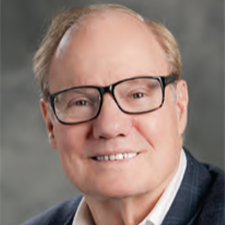
Contributed by Brittany Hodges, MD, and Pradeepa Yoganathan, MD, MSc, FRCSC, FASRS
Jerry A. Shields, MD, was born on June 9, 1937 in a rural town in Pride Station, Union County, Kentucky.1 Coming from a humble agricultural background,2 he was the youngest of eight children. As a child, he had an innate sense of worldly curiosity. He was known to spend his free time outdoors, fascinated by butterflies. Collecting thousands of specimens, he meticulously catalogued them by species and genus, which culminated in the second largest butterfly exhibition in the United States at the time.3 This penchant for deep scientific investigation set the stage for a lifelong career of clinical discovery and treatment innovation, leaving an indelible mark within the field of ophthalmology. Along with his wife, Carol L. Shields, MD, he became the preeminent expert in ocular tumors, and the most revered trailblazer of ocular oncology breakthroughs around the world.
Dr. Shields attended Sturgis High School in southwest Kentucky, where he excelled both athletically and academically. As a top-performing athlete, he made both all-star football and basketball teams.4 He graduated from Murray State University in 1960 on a football scholarship and earned his medical degree from the University of Michigan in 1964. He then valiantly served his country as a battalion surgeon in the United States Marine Corps during the Vietnam War and later in Europe with the United States Navy.5
When he returned to the United States, he completed ophthalmology residency at Wills Eye Hospital in 1970. He pursued an ophthalmic pathology fellowship at the Armed Institute of Pathology in 1971 and subsequently completed vitreoretinal surgery fellowship in 1972 at Wills Eye Hospital.3 In 1974, he established the Ocular Oncology Service at Wills Eye Hospital, one of the first eye cancer centers in the world. Today, it has blossomed into the largest tertiary referral center for eye cancer around the globe, with over 150 new cases of retinoblastoma and 500 new cases of uveal melanoma treated annually.6
Throughout his five-decade tenure, he authored 2,000 scholarly articles, 700 textbook chapters, and 13 complete textbooks on ocular tumors.3 Moreover, he has trained 300 ocular oncology fellows globally, which is particularly striking given that there were only 10 physicians interested in ocular oncology when Dr. Shields first began his career.6 For his prolific contributions to the field, he has received over 40 prestigious accolades, including the 2013 National Physician of the Year Award for Clinical Excellence and the Academy of Ophthalmology’s highest honor, the Laureate Award in 2014.4
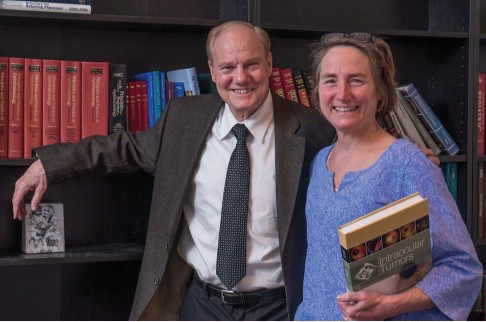
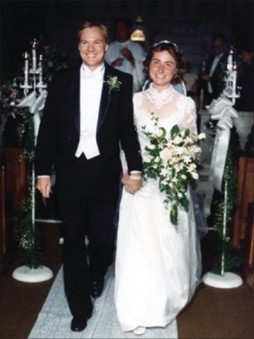
Dr. Shields’ career has been marked by profound clinical advances, research innovation and scientific discovery in the field of ocular oncology, much of it in close collaboration with his wife, Dr. Carol L. Shields, whom he first met during a mixed doubles tennis event in 1984.7 They married in 19851 and quickly became a dynamic team duo off the court, contributing significantly to the scientific literature. Notably, they become pioneers in the application of plaque radiotherapy in the treatment of intraocular tumors. In the 1970’s, intraocular tumors were typically managed through enucleation or irradiation.2 However, Dr. Shields revolutionized intraocular tumor management by offering phosphorus (P32) diagnostic testing and plaque radiotherapy. While P32 testing is no longer favored due to other preferred imaging modalities, plaque radiotherapy remains the most popular technique for local control of uveal melanoma to date.8 Similarly, Dr. Shields has spearheaded advances for retinoblastoma care, pioneering methods for intra-arterial and intravitreal chemotherapy.
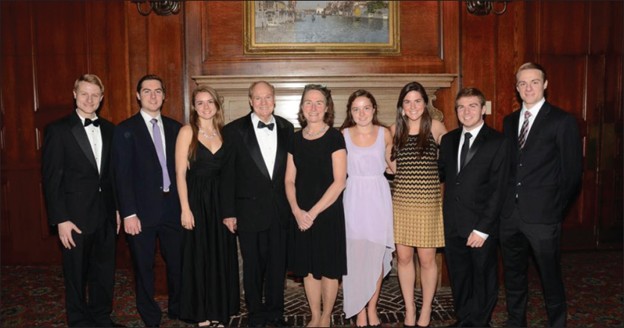
Dr. Jerry Shields passed away peacefully at home, at the age of 88, on June 22, 2025 surrounded by his family. He is survived by his seven children, most of whom are pursuing their own careers in medicine.2 His legacy is a testament to intellectual curiosity, rigorous research and compassionate care, one which has inspired generations of physicians and who has saved countless lives around the globe.